Victorian Era Superstitions Were Barmy and Strange

The Victorian Era (1837-1901), was a strange and prudish time, when the sight of a bare ankle was deemed scandalous and people often used the language of flowers to convey their feelings.

While the homes of the era were often dark and gloomy, filled with over-stuffed furniture and cabinets of taxidermied birds and skewered butterflies behind glass, the funeral customs were often highly theatrical and elaborate, shrouded in superstition and belief in the supernatural.
When Prince Albert died in December 1861, Queen Victoria was plunged into a period of intense mourning. She wore black for the remaining forty years of her life and rarely appeared in public.
However, the rules of mourning for most people, at this time, were also rigid, complex and expensive. 

The main reason for the strict adherence to mourning rituals was that death was more commonplace and public than it is today. Three out of every twenty babies might die before their first birthday in those days and the elaborate customs provided a sense of stability. There was also the superstitious idea that additional deaths might be avoided by following certain rituals.

Cover The Mirrors

When someone died, the curtains of the house were closed, clocks became silent and mirrors were covered, because of the belief that the spirit of the deceased might become trapped in the glass. 

If you were out walking one day and you happened to run into a funeral procession, it was believed that this may bring you bad luck. If you were able, then it was advisable to turn around and go another way. However, if this was not possible and you had no choice but to continue toward the funeral party, then you could avoid bad luck and a bad future, by holding tightly onto a button. How the button attained this power was never explained. 
John Hislop Undertakers, Brisbane, circa1902
The dead mostly stayed at home, until the burial in the Victorian era. For the poor with limited space, this might mean having grandma in the front parlour, or a dead sibling in the same room. But most families, rich and poor, put themselves into debt to properly respect the dead and give them a decent burial.

Black Ostrich Feathers 

Coffins might be of rich, expensive timbers and intricately carved. Horses might be adorned with black ostrich feathers and the hearse was often expensive and black as night. Professional mourners (called mutes) might be hired to take part in the funeral procession and deep mourning required the wearing of black clothing and armbands for men, for a prescribed amount of time. A widow was expected to mourn her husband and wear black for at least two years. After this, there was a period of "half mourning", when dresses of grey or lavender could be worn.

Shops had to supply these morning clothes and Jay’s of Regent Street, London, was one of the best. Women might also buy a mourning broach and keep a lock of the deceased's hair inside, or wear jewellery made from jet. The poor, however, often dyed their clothing and then bleached it after the period of mourning had finished, as the cost of another set of clothes was beyond their means.
 Mrs Brown is dressed in mourning following the death of her husband, circa 1908
Harbingers Of Death

After the funeral and the mourning period had finished, it was still not possible for the Victorians to relax as they believed in so many superstitions and omens about death. For example, if a person smelled roses and there were no roses about, then this was considered a harbinger of death. Yours or someone else close to you. Seeing an owl in the day time was also an omen of death, as was three knocks at the door and no visitor; a dog howling, a vase of red and white flowers together and opening an umbrella inside the house, were also dire. 
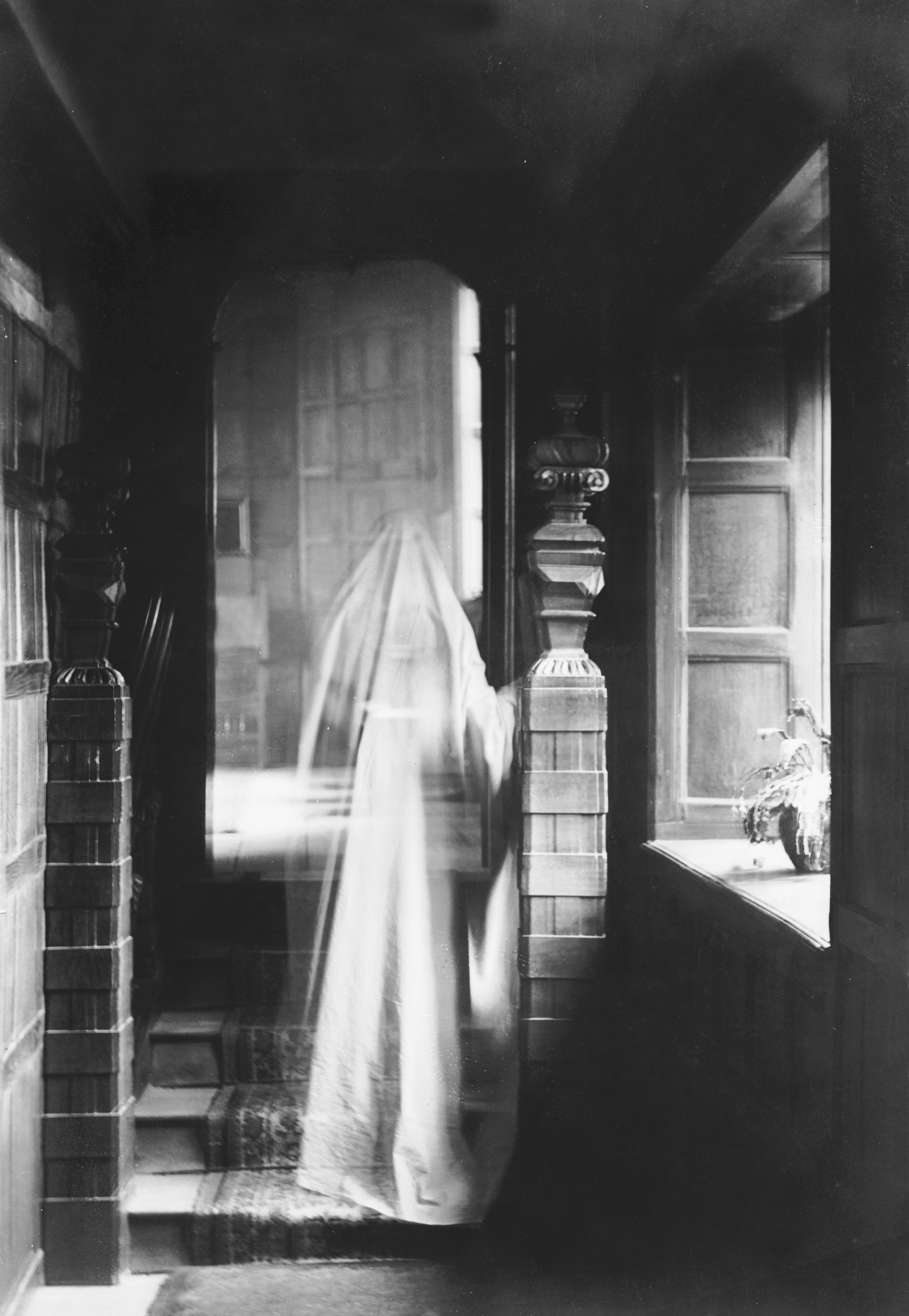
People in the Victorian era thought that tying black ribbons onto things could stop death and so black ribbons were tied to doorknobs and added as trimmings on underwear and handkerchiefs and even pets would have be-ribboned tails. If a family had experienced too many deaths, in a short amount of time, they may have insist that guests to their home wear a crepe ribbon, as they stepped through the door....just in case.


De mortuis nihil nisi bonum. "Of the dead, [say] nothing but good"


Books To Read


Rebecca, by Daphne du Maurier. “Last night I dreamt I went to Manderley again.”

The Witch Suspected Of Killing Between 1,000 and 2,500 People


Catherine Monvoisin, born in about 1640 (maiden name Deshayes), lived during the reign of Louis XIV and was commonly known as La Voisin. She was a French merchant, a poisoner and an alleged sorceress, who was seriously into black magic and devil worship.
Monvoisin's husband was a jeweller with a shop at Pont-Marie, not far from the Louvre. After her husband went bankrupt, she began practising palm-reading and face-reading (physiognomy). She was a midwife but she became an abortionist, with many wealthy and aristocratic clients.

Soon, Monvoisin added the selling of love potions and aphrodisiacs to fortune telling, and then, other potions were created by her for the purposes of bringing about the death of an enemy or a spouse. Theses potions would contain such things as toad bones, human blood, ground up mummies and moles' teeth.

Business was booming and Monvoisin wanting to really look the part of the successful sorceress, purchased an extravagant red velvet dress embroidered with gold eagles for the price of £ 1 500, which was a small fortune in those days.

With many clients among the aristocracy, like Olimpia Mancini, Countess de Soissons; Maria Anna Mancini, Duchess of Bouillon; Elizabeth, Countess of Gramont ("the beautiful Hamilton") and François-Henri de Montmorency, Catherine Monvoisin was raking in the money.
Elizabeth Hamilton, Countess of Gramont
Although Catherine Monvoisin supported her family of six, including her husband, she also had six lovers, including the executioner, Andre Guillaume and magician Adam Lesage. One of her lovers, Monsieur Latour, abused her and she was known to be an alcoholic.

Monvoisin's abortion business grew and she had others working for her performing abortions; such as the midwife, Catherine Lepère, who was later exposed and executed by hanging. Claims were also made that the aborted fetuses were burned in a furnace and buried in the garden of Monvoisin's home.

Black masses were conducted by Monvoisin where the blood of babies would be gathered in a bowl over an altar and people would pray to the devil to fulfil their wishes. It was alleged that Monvoisin paid prostitutes for their infants to use in her rituals.

Adam Lesage, a professional occultist and alleged sorcerer, also helped with the magical rituals; like the one with the royal mistress, Madame de Montespan, who requested that Satan help her gain the king's love. Montespan did subsequently become the official mistress of the King, and after this, she employed Catherine Monvoisin whenever she had a problem in her relationship with the King.
Louis XIV. He first met Madame de Montespan at the Palais du Louvre.
The priest Étienne Guibourg also performed Black Masses with Catherine Monvoisin. The English clergyman and author, Montague Summers, gave this account of one of the masses:

A long black velvet pall was spread over the altar, and upon this the royal mistress laid herself in a state of perfect nudity. Six black candles were lit, the celebrant robed himself in a chasuble embroidered with esoteric characters wrought in silver, the gold paten and chalice were placed upon the naked belly of the living altar [...] All was silent save for the low monotonous murmur of the blasphemous liturgy [...] An assistant crept forward bearing an infant in her arms. The child was held over the altar, a sharp gash across the neck, a stifled cry, and warm drops fell into the chalice and streamed upon the white figure beneath. The corpse was handed to la Voisin, who flung it callously into an oven fashioned for that purpose which glowed white-hot in its fierceness.
In 1673, the king Louis XIV lost interest in Madame de Montespan and in 1679, he entered into a relationship with Angélique de Fontanges. Madame de Montespan then requested that Catherine Monvoisin have both the King and Fontanges killed. However, before Catherine Monvoisin could make an effective murder attempt on the king and his new mistress, a public riot took place where people accused witches of abducting children for the black masses. This led to the arrest of various famous fortune tellers of Paris and then, to the arrest of Catherine Monvoisin herself.
Mme de Montespan, by Pierre Mignard, c 1670
Monvoisin was executed in Paris on 22 February 1680.


Books featuring Catherine Monvoisin

The affair of the poisons : murder, infanticide, and Satanism at the court of Louis XIV by Anne Somerset. 

The Affair of the Poisons: Louis XIV, Madame De Montespan and One of History's Great Unsolved Mysteries by Frances Mossiker. 

Athenais: The Real Queen of France by Lisa Hilton.

Baneful Sorceries or The Countess Bewitched by Joan Sanders 

The Oracle Glass by Judith Merkle Riley
 
Strange Revelatios: Magic, Poison, and Sacrilege in Louis XIV's France by Lynn Wood Mollenauer

This Dude Was Talking at Four Months of Age

Michael Kevin Kearney was born in 1984 in Hawaii and by four months of age he was learning to talk and could ask his parents "What's for dinner?"

At the age of six months Michael was able to tell the paediatrician, "I have a left ear infection". I wish I could have seen the doctor's face. Then, at 8 months he was learning to read. Not really fair is it?

Michael was homeschooled by his parents, especially, by his mother, Cassidy, a Japanese American. But at age four he became a member of Mensa, whose members have IQs in the top 2 percent of the population. His younger sister, Maeghan, is also a child prodigy.

As a toddler, Michel took the television apart and tried to see if the cat could fly.

Believe it or not, at six years of age Michael had earned his school certificate and enrolled in junior college. He was also diagnosed with ADHD but his parents rejected the use of drugs for the condition. Another doctor called him retarded. Really!

At age eight, Michael earned an associates degree and in 1994, he received a bachelor's degree in anthropology, from at the University of South Alabama.

At 14, Michael had a master's degree in chemistry from Middle Tennessee State University and at age 18, he earned a master's degree in computer science from Vanderbilt University.

When Michael was 22, he earned his doctorate in chemistry from Middle Tennessee State University. He has also appeared as a contestant on various games show and won twenty-five thousand dollars from Who Wants to be a Millionaire? He has also appeared on Drunk History, an American educational television comedy series and performed at Nashville Improv.


Books To Read

The Believing Brain: From Ghosts and Gods to Politics and Conspiracies---How We Construct Beliefs and Reinforce Them as Truths, by Michael Shermer.

Animals and Virgin Birth: No Daddy Needed


Virgin birth or asexual reproduction, which is otherwise known as Parthenogenesis, is not as rare as you might think. Recently, virgin birth has been observed in certain types of snakes, but other animals like chickens, sharks, lizards and plenty of species of bees and insects can do it.

There are different mechanisms involved in creating offspring in this way. However, basically, full clones have all their mother's genetic material and half-clones, which can occur due to terminal fusion, have a little over half the mother's genetic material.

The fearsome and let's face it, ugly, Komodo dragon, is the largest living species of lizard and this monster, believe it or not, can replicate itself without the need of a daddy. Offspring are not exact clones, as genetic material gets shuffled about. Generally, however, Komodo dragons do form pair bonds and have a once a year mating period. Males, as usual, fight over desirable females and often, vomit or defecate when getting ready for a brawl.
Komodo dragon
Certain types of sharks are also capable of virgin birth like the odd-looking hammerhead shark. Hammerheads, too, usually have a once a year mating period and the mating process usually involves the male shark aggressively biting the female, until she will mate with him. Female sharks, however, can fertilise their own eggs (sounds preferable), by parthenogenesis, but usually, there will be only one offspring produced.
The hammerhead shark
The humble chicken and turkey can also clone themselves, if there is no male to oblige. However what about us humans? Hwang Woo-suk, a former professor at Seoul National University claimed that he had successfully cloned a human embryo. However. rather than a story of pioneering science, this case turned into a tale of fraud, scandal and shame.


Books To Read

The Prestige, is a novel by British writer Christopher Priest. The events of the past are revealed through the diaries of magicians Rupert Angier and Alfred Borden. The diaries read by their great-grandchildren, Kate Angier and Andrew Westley (born Nicholas Borden) in the present day, and diary entries are interspersed with events of Kate's and Andrew's lives throughout the novel.

Isaac Newton: A singular Fellow and Genius

Isaac Newton is widely considered to have been a genius. He was an astronomer, mathematician and physicist, whose ideas laid down some of the most important scientific foundations. However, he was also a very odd fellow.
Godfrey Kneller's 1689 portrait of Isaac Newton (age 46)
Newton did not get on too well with others, he was very private and extremely introverted. He seems to have had a bit of a temper and was known to resort to violence, by giving out a beating to those he believed deserved it. Newton also tried to destroy the reputation of Gottfried Leibniz, who had discovered calculus at around the same time as Newton. At university, Newton was generally considered a poor scholar, as he mostly disregarded the subjects that he was supposed to be studying. Luckily, his mathematical genius was noticed. 

When he was young he actually made up a list of sins that he had committed and one of them was "Beating Arthur Storer". Another sin was making a mousetrap on Sunday and another was "squirting water" on the Sabbath. Woopie-do!
Woolsthorpe Manor, Lincolnshire, birthplace of Sir Isaac Newton
Newton was also a religious zealot, but he had his own set of radical ideas. He was a Catholic but did not believe in the Trinity. He also believed that worshipping Jesus as God was a sin. Newton did, however, end a friendship with an acquaintance who made a joke about a nun. On his death bed, Newton refused to receive the sacrament and he also said that his greatest achievement in life was that he would die a virgin. 


Books To Read

All Cats Have Asperger Syndrome, by Kathy Hoopmann

500 Years After Martin Luther We Have A Robot Priest

It was in Wittenberg, Germany, where Martin Luther lived and preached that he nailed his 95 Theses, to the door of the Castle Church, on October 31, 1517. Now, 500 years later, in the same town, we have a robot priest who is again challenging religious tradition.

The robot called BlessU-2, can deliver blessings in five languages, as beams of light shine from its hands. However, whilst there is an undoubted worldwide lack of priests, the purpose of this robot, is to make people question whether a robot could ever replace a priest in his role and deliver pastoral care.

Just thinking about how my local priest had to resign a few years ago because he was carrying on with five married women in his parish and all the many other scandals in the priesthood in recent years, this robot may well be a good idea.
BlessU-2

Books To Read

The Science of Good and Evil: Why People Cheat, Gossip, Care, Share, and Follow the Golden Rule, by Michael Shermer.

Psychopaths in Power


Psychopaths, according to research, are prevalent in positions of power. This is because they crave the influence, authority and sense of importance that powerful positions can bring them. And mostly, psychopaths are prepared to do whatever it takes to get to where they want to go.

Psychopaths are all around us. Especially above us making the decisions and manipulating people and situations to suit their own agenda. Psychopaths will say one thing and to do another. They know how to appeal to and manipulate people, To get what they want. Which means that the powerful psychopath might say, "I understand what you want and I know how to deliver it", whilst manoeuvring and steering things to his own advantage.

Power, prestige and money are great motivating factors for most psychopaths. It is estimated that about one in five corporate bosses are psychopaths and psychopaths are over-represented in politics, where Machiavellian, ruthless-grandstanding is the order of the day.
The three personality traits which define psychopaths are referred to as the “dark triad.” They are narcissism, psychopathy and a tendency toward Machiavellian behaviour. And according to research, people with these dark tendencies seem to be skilled at making themselves more attractive to us, often by wearing flashy clothing, projecting confidence and through attractive facial expressions.

Most of us feel the powerful pull of these people with dark tendencies. This is why the brooding bad boy and the mean girls at school seem to get away with so much. The sense of power and confidence that these damaging people project really seems to beguile and attract others.

The problem is, that the rest of us are letting the psychopaths, narcissists and Machiavellian types rule our world. We are being conned by the bold and confident behaviour of these people who only wish to exploit the rest of us. We are letting these dark types build their oligarchic systems in our schools, our workplaces and our countries. As it stands, we are the puppets and they are the masters. But perhaps, one day, we can wise up and change the current state of the power play. Perhaps.


Books To Read

Without Conscience: The Disturbing World of the Psychopaths Among Us, by Robert D. Hare.