Women First Given Vote......By Accident

New Zealand was the first country in the world to grant national voting rights to women, when the Governor, Lord Glasgow, signed the Electoral Act into law on 19 September 1893.

Australia, however, was the first country in the world to give women both the right to vote in federal elections and the right to be elected to parliament on a national basis. Britain and the United States, on the other hand, did not give women the right to vote until after the First World War. Women in Saudi Arabia did not get to vote until 2015.

But women in Victoria, Australia, actually had the right to vote back in 1863, when the Electoral Act 1863 gave "all persons" listed on local municipal rolls the right to vote in elections. Some women in Victoria obviously realized they were actually "persons", and so, they took advantage of this law and voted in local elections. A newspaper article reported:

“At one of the polling booths in the Castlemaine district a novel sight was witnessed. A coach filled with ladies drove up, and the fair occupants alighted and recorded their votes.”
The Argus, 5 November 1864, p 4.

The accidental enfranchisement of women was taken away in 1865 when the law was changed.
Suffragette movement in Queensland, 1909.

The Unfortunate Inventor

The American Doctor Thomas Midgley Jr. (1889 –1944) was a mechanical engineer and chemist; he was also an inventor, but not a very good one in the end.

Whilst working for a subsidiary of General Motors in 1911, Midgley discovered that the addition of Tetraethyllead to gasoline prevented "knocking" in internal combustion engines. But instead of saying that lead was being added to petrol, the company decided to call the additive "Ethyl".
Then in 1923, Midgley had to take a bit of a holiday because he had lead poisoning. Luckily,  Midgley was a grown man, because developing children who are exposed to lead are often cognitively impaired, with lower intelligence, exhibiting aggressive behaviour, because lead competes with calcium in the cell, which is very important for brain development.

Interestingly, the lead-crime hypothesis proposes that the decrease in crime in America that began in the mid-1990s and continues today, may be due to lead being removed from petrol.

After this, Midgley was involved in the invention of chlorofluorocarbons (CFCs), called Freon. This substance was used refrigerators, inhalers and aerosol spray cans. Later we found out that these type of gases have depleted the ozone layer and contributed to the greenhouse effect, which is impacting natural ecosystems and biodiversity and a factor behind climate change.

These two inventions have now been banned. J. R. McNeill, an environmental historian expressed the opinion that Midgley "had more impact on the atmosphere than any other single organism in Earth's history."

Midgley died in 1944 when he became entangled in one of his own inventions, which he had created after polio left him disabled. The system of strings and pulleys that he devised to help others lift him from bed, strangled him. At least he tried.


Books To Read

Mistakes That Worked: 40 Familiar Inventions & 40 Familiar Inventions & How They Came to Be, by Charlotte Foltz Jones.

Off With The Fairies

I have never believed in any sort of supernatural beings; people are different, after all. But I have always been mystified as to why the various gods seem only able to communicate their contradictory ideas and messages through ancient books and inside the heads of some people. And why are the gods silent when hideous violence is committed by mad people in their name. But perhaps that's just me.

Before Christianity, which is followed by 2.1 billion people and Islam (1.3 billion), there was Hinduism (900 million) and Buddhism (376 million). And before these religions, which are still practised, there was Paganism.

The Irish version of paganism was particularly imaginative and interesting with beliefs in fairies like the Leprechaun and the Banshee. The leprechaun makes an appearance in the medieval tale known as the Echtra Fergus mac Léti (Adventure of Fergus son of Léti); but their origin can probably be traced back to 8th-century tales of water spirits, which were known as ‘luchorpán’. A banshee, on the other hand, is a female spirit in Irish mythology, who predicts the death of a family member, usually by shrieking or keening. The origin of the banshee may be traced to the keening mourning women at funerals, who accepted alcohol as payment for their services and were later condemned by the church.
Banshee by Michael1010
There were lots of other fairies like the headless dullahan, a black-robed horseman, who carries his head on his saddle. He can see at great distances, even at night, but if you see him, you will be rewarded with a bowl of blood thrown in your eyes or even blindness.

The pooka is a fearsome fairy who can take many frightening forms. It roams about the county at night and the sight of it can stop the hens from laying and the cows from giving milk. If you happen to be in county Wexford and you look up and see a huge eagle, run, as it might just be a pooka. The pooka may derive from the horse cults of early Celtic times.
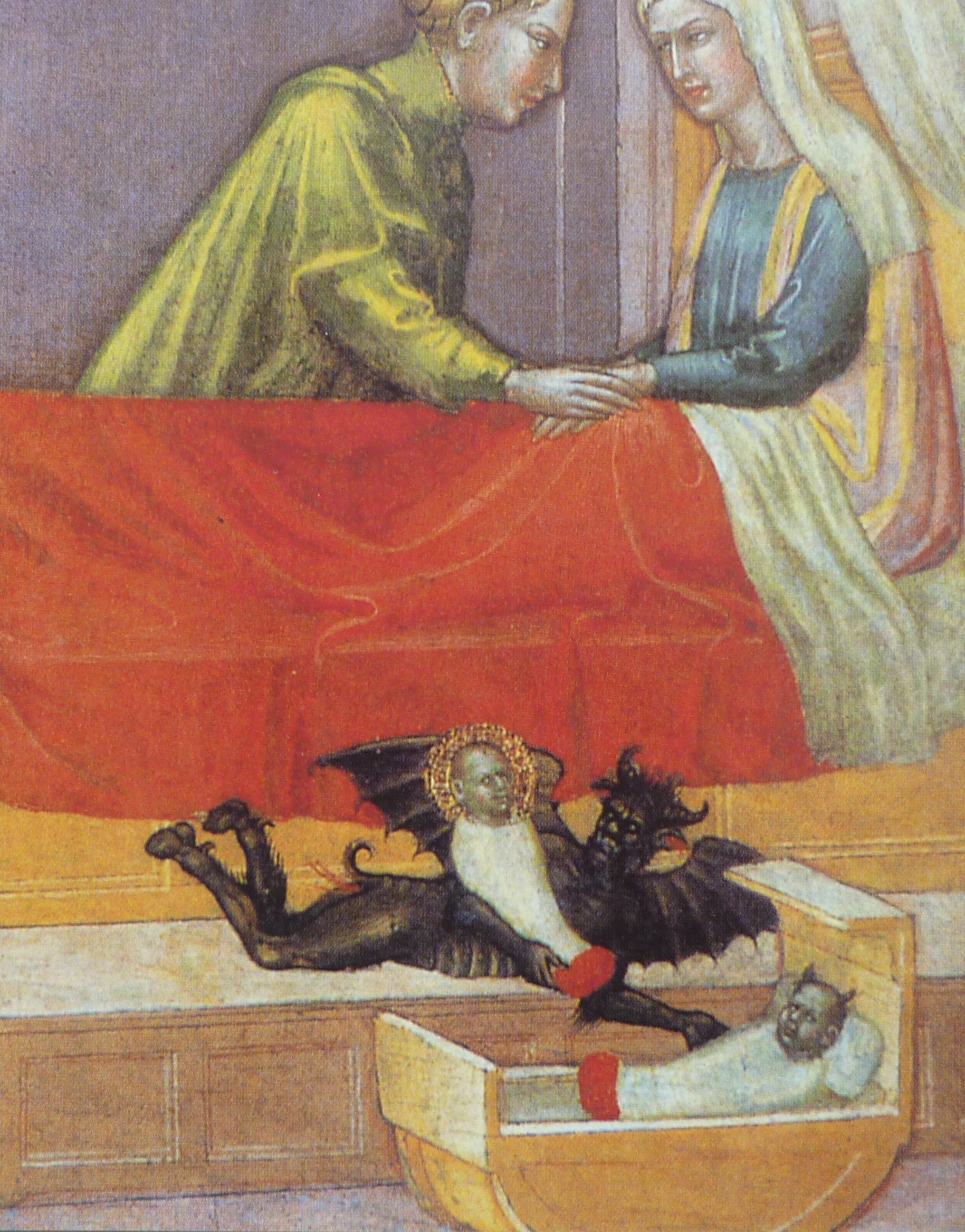
As an avid reader of fairy tales in my childhood, I can recall the frightening concept of the changeling, which may be a stunted and often deformed baby born to the fairy folk. These fairy folk, however, prefer a perfect human child, and so, perform a swap-see. It gets worse though, because changelings can also be demented old fairies disguised as children, or, objects such as pieces of wood which take on the appearance of a child through magic. The changeling idea may have provided an explanation for a child born who was mentally or physically impaired, in some way.

There are other fairies of course, but you may seek them out for yourself.


Books To Read


Beasts of the Frozen Sun (Frozen Sun Saga #1) by Jill Criswell - inspired in Celtic and Viking mythology.

When Only a Few Thousand Humans Lived on Earth

Between 50,000 and 100,000 years ago, there occurred a very sharp decrease in the human population, so that only 3,000–10,000 individuals lived on Earth. Evidence of this very small human population is supported by genetic evidence.

Humans came very close to extinction at this time, because only about 1000 of these individual humans were capable of producing offspring. Humankind struggled to survive for thousands of years, until some time during the Stone Age.

You may have heard the theory about how climate change caused by a volcano helped to bring about the near extinction of dinosaurs (chickens still exist), well, around 70,000 B.C., a volcano called Toba, on Sumatra, in Indonesia, almost wiped out humanity.

As the largest volcanic eruption ever known, Toba poured so much ash, dust and vapour into the air that ash covered the ground and the sun's light was dimmed for about six years. Food became scarce and the Earth became cold and vegetation was wiped out.

Humanity recovered. In 1750 there were 700 million people on the planet and in 1804, the human population reached one billion individuals. Currently, human population appears to be out of control with in excess of 7.5 billion people sharing this planet.

With humanity threatening to overcome the carrying capacity of Earth, we face a future of climate change and possibly wars over diminishing and scarce resources. And yet, the subject of human population is rarely mentioned.


Books To Read

The Crack in Space is a 1966 science fiction novel by American writer Philip K. Dick. On a future Earth (c. 2080 CE) overwhelmed with severe difficulties related to overpopulation.

John Stuart Mill's Odd Childhood

Undoubtedly, John Stuart Mill the English philosopher was a genius who made significant contributions to social and economic theory. It was, however, his father, James Mill's intention to create a genius.

James Mill was a Scottish historian, philosopher, political theorist and economist, who had a definite education plan in mind for his son. And so, John Stuart Mill was homeschooled and taught to read at the age of two.

By the age of three, John Stuart Mill was learning Greek and by the age of eight, he was quite familiar with Xenophon's Anabasis, the writings of Herodotus, Lucian, Diogenes Laërtius, Isocrates and Plato. He also read widely and studied history, arithmetic, physics and astronomy.

Mill's father was not a warm or loving man as he regarded emotions as being akin to madness. He was also somewhat of a tyrant, as well as being self-controlled and stoic. But whilst he was greatly possessive of his son, he also berated him for his stupidity, causing John Stuart Mill, the man widely regarded as a genius, to have a life-long inferiority complex.

John Stuart Mill
Not being permitted to mix with other boys of his own age, John Stuart Mill mixed with his father's friends. Friends like Jeremy Bentham, the English philosopher, another political radical. He was also denied holidays, as his father believed that such an indulgence would lead to idleness.

So John Stuart Mill spent his childhood deep in rigorous studies under the severe eye of his father, in an atmosphere of fear and repression. Though, Mill admired his father in many ways for his civic spirit, his intellect and his moral values.

As to Mill's mother, she seems to have figured little in his emotional and intellectual development; though it seems that Mill would have liked to have had a warm-hearted, sensitive and affectionate mother, she too was subjugated by her husband to be so.

This emotionally deprived childhood and the ambivalent feelings aroused in John Stuart Mill, led to a mental breakdown at the age of 20, when he descended into depression. Mill, also, had become disillusioned with some of his father's ideas and he wanted to be more independent. He described himself as a ship without a sail.

After about a year of gloom, Mill was able to enjoy "in sunshine and sky, in books, in conversation, in public affairs". And soon, he would meet Harriet Taylor, who would bring Mill lots of happiness, even though they had to wait 21 years to be married. But that is another story.  


Books To Read

Is It Just Me?, by Miranda Hart - for the clumsy and awkward.....like me.

The Guinea Pigs of Lithium

How lithium came to be used as a treatment for bipolar disorder is quite an interesting story, which began at a Mental Hospital in Melbourne, Australia.

Dr John Cade (1912 –1980) was an Australian psychiatrist who served in the Armed Forces during World War II. Cade, however, became a prisoner of war at Changi Prison from 1942-1945.

Little was known about the causes of bipolar disorder back in the 1940s, but Cade had the idea that patients suffering from this condition may have had a metabolic disorder, which could be ascertained by the levels of urea in their urine. He believed that mania would cause an excess of uric acid in the urine and depression, he believed, would result in a deficit of uric acid.

So Cade began to conduct experiments which involved injecting urine from mentally ill patients into the abdomen of guinea pigs; only to find that the guinea pigs injected with the urine of the mentally ill patients died much faster than those that were injected with a healthy sample of urine

Acting on his hypothesis, that uric acid was present in the urine samples, provided by his mentally ill patients, Cade tried to increase the water solubility of uric acid and so he added lithium urate. 

After Cade added the lithium to the guinea pig injections, he found that the animals became very docile and quiet and they did not run about in their usual manic manner.  
Before testing lithium on his patients, Cade first tested the substance on himself for a few weeks and then, he began to give lithium to one of his patients, a man who was alienated from his family and who had been living in the asylum for 30 years, called Bill. 

With the lithium, Bill began to improve and his speech and self-care became better. After a while, Bill was able to return to his job. 

Unfortunately, Bill stopped taking lithium and his mental health deteriorated and he had to return to the asylum. 

Not knowing about the toxicity of lithium at high dosages, Cade gave Bill increased amounts of lithium, in an attempt to restore Bill's sanity. In 1950, Bill died from lithium toxicity. 

Over time, more research was conducted on lithium as a treatment for bipolar disorder to establish safe and effective dosages.
There are various ways proposed that may explain how lithium may work as a mood stabiliser, such as inhibition of protein kinase C and glycogen synthase kinase 3 and inositol-depletion.


Books To Read

The Marriage Plot, by American writer Jeffrey Eugenides. The story concerns three college friends from Brown University—Madeleine Hanna, Leonard Bankhead, and Mitchell Grammaticus—beginning in their senior year, 1982, and follows them during their first year post-graduation.

Your Plastic Clothes and Inter-generational Theft and Destruction


Synthetic clothing made from nylon, polyester, acrylic, polypropylene and lycra, are made from petroleum and petroleum is a finite resource, as it takes so long to form. In fact, 70% of the world's oil deposits were formed in the Mesozoic age 252 to 66 million years ago.

When our deposits of petroleum are exhausted, they cannot be restored.

A lot of the fashion for sale today in the big shopping malls are made of synthetic fibres. These cheap, "plastic" clothes are not only awful to wear, as they make you sweat and itch, but they also look bloody awful after they are washed, and so, are often thrown out after only being worn a few times.


While clothing made from natural fibres are more easily biodegradable, synthetic fibres, generally, will outlive you. And as they sit in landfills, they shed microplastic particles into the environment. But even before you get rid of your synthetic clothes, they are releasing more than 700,000 microscopic plastic fibres in each washing load. These microplastics poison the food chain, building up in the digestive tract of animals, reducing their ability to get energy from their food, and in some cases, changing animal behaviour.

While many right-wing newspapers continue to claim that the Earth has more oil than it needs, this is not strictly true. The official industry view is that global reserves will last 53 years at current rates of consumption. But as oil reserves get ever harder to access, some countries, like the US and China, who are desperate to be self-reliant and sustain cheap sources of oil, have resorted to "fracking"; this is where high-pressure water, chemicals and sand are blasted deep into rock to release oil and gas reserves.

Fracking can contaminate underground water supplies, cause minor earthquakes and release toxic wastewater into the surrounding environment. Canada also produces around 1.9 million barrels of oil a day from tar sands, which Al Gore, the climate activist has described as "the dirtiest source of liquid fuel you can imagine".

But this sense of entitlement that many of us have, when we buy and quickly discard cheap, plastic clothing, has more than huge environmental costs. We are also, essentially, stealing from our children and following generations, who will have to deal with the results of this outrageous material consumption, as they, at the same time, are denied a share in the bounty, as resources are fast depleting.
In past generations, most people were thrifty and frugal, buying clothing of quality, which would last. Virtues that we should resurrect in this era of narcissistic, "I deserve it", consumption; because, the world's human population is still growing and more people are wanting to buy more and more clothes. The earth's resources and its environment have limits, but the squandering and degradation continues as I type this page.

Books To Read

The Stone Gods, by Jeanette Winterson. This novel opens on the planet Orbus, a world very like Earth, running out of resources.